Unplug and Play: The Latin Music Fans Ditching Algorithms for Listening Rooms, Vinyl Nights, and Real Talk
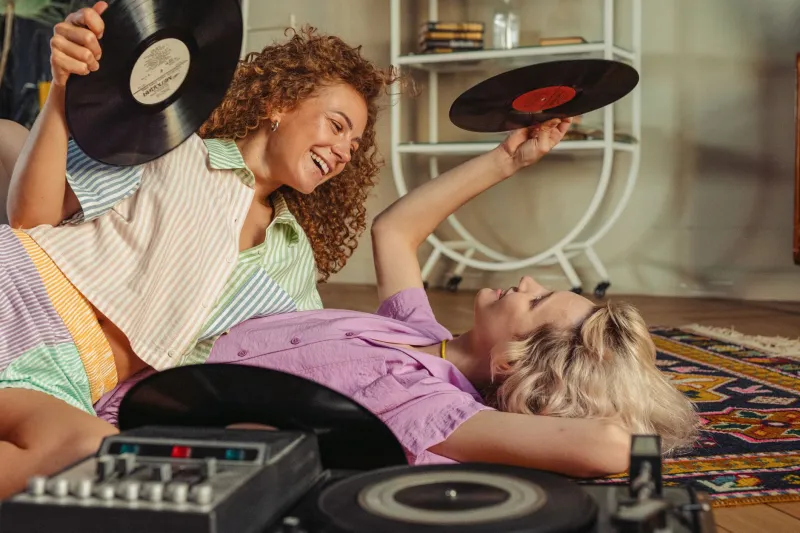
Somewhere in a converted garage in East Los Angeles, about thirty people are sitting in mismatched chairs listening to a cumbia record from 1974. Nobody's on their phone. Nobody's asking a speaker to play something similar. The host — a woman named Patricia who works in healthcare and has been collecting Latin vinyl for fifteen years — just lifted the needle, set it down, and said: "Listen to the bass. Just listen to the bass."
And everyone did.
This is a listening club. It has no official name, no social media presence, and no algorithm deciding what comes next. It runs on word of mouth, a shared Google calendar, and Patricia's collection of roughly two thousand records.
"I got so tired of Spotify deciding what I was supposed to like," she says afterward, refilling someone's glass of horchata. "Every time I opened the app, it was like talking to someone who had only met me once and was trying to predict everything about me based on that one conversation. I wanted to hear music I didn't know. I wanted to be surprised. And I wanted to talk about it with actual humans."
Patricia's garage gathering is part of a growing, loose-knit movement happening in cities across the United States — a counter-response to the algorithmic saturation of Latin music consumption, driven by fans, musicians, and community organizers who've decided that the streaming experience, for all its convenience, is missing something essential.
The Algorithm Problem, in Plain Terms
Let's be honest about what streaming platforms do: they optimize for engagement, which means they serve you more of what you've already shown you like. That's comfortable. It's also, over time, a little suffocating.
For Latin music specifically, the problem is compounded by the fact that algorithms tend to flatten an enormously diverse ecosystem into a handful of dominant genres. If your listening history skews reggaeton, you're probably not getting recommended sones istmeños from Oaxaca or Venezuelan joropo or Uruguayan candombe. The platform doesn't know those things exist in the same universe as what you've been playing.
"The algorithm basically decided that 'Latin music' means six things," says DJ and music educator Renaldo Fuentes, who runs a vinyl-only monthly event called Tierra y Surco in Denver. "And if you grew up hearing something outside those six things, you start to feel like your music doesn't exist. Like it's been erased."
Renaldo started Tierra y Surco three years ago, initially as a birthday party for himself. He played only records — no digital files, no streaming — and he picked music from across the Latin American spectrum: Afro-Peruvian festejos, Argentine tango nuevo, Puerto Rican plena, Tejano from the 1980s, Mexican son jarocho. People stayed for four hours. They asked when the next one was.
"I realized people were hungry for this," he says. "They were hungry for music that wasn't pre-sorted for them."
What These Spaces Actually Look Like
The offline Latin music movement doesn't have a single shape. It shows up differently depending on who's organizing it and what community it's serving.
In Miami, a collective called La Sala runs quarterly listening sessions in a rented gallery space, each one focused on a specific country or regional tradition. Attendees receive a printed program — yes, on paper — with liner notes, historical context, and discussion questions. The sessions run about two hours, followed by open conversation. No dancing, no background noise. Just listening, together, with intention.
In Chicago, a group of musicians and music teachers hosts what they call "rondas" — informal circular jam sessions held in rotating living rooms, where the rule is simple: no streaming, no YouTube tutorials, no looking up chords on your phone. You play what you know, you learn from the person next to you, and if you don't know something, you ask.
"It's how music was learned for centuries," says Gabriela Méndez, one of the ronda organizers. "Ear to ear, person to person. The phone in your pocket has a million songs on it, but it can't teach you how to feel a rhythm in your body. Only another person can do that."
In New York, a bookstore in Washington Heights has been hosting monthly "escuchas" — listening sessions — that pair a record with a short reading from a Latin American writer, creating an immersive pairing of sound and text. The events sell out in hours.
The Vinyl Factor
Records keep coming up in these conversations, and it's not purely nostalgia. Vinyl creates a specific kind of listening experience that streaming can't replicate: it requires physical engagement, it has a finite runtime per side, and it degrades with poor handling — all of which conspire to make you pay attention.
There's also something about the search. Finding a specific pressing of a cumbia record from Barranquilla, or tracking down a hard-to-find LP of Celia Cruz's early work, requires effort. That effort creates investment. You care more about music you had to hunt for.
"When I hand someone a record and say, 'This is from 1968, this is a first pressing, this traveled from Colombia to New York in someone's suitcase' — the music sounds different to them," says Patricia, back in her East LA garage. "The context is part of the experience."
Preservation as Resistance
Several of the organizers we spoke with framed their work explicitly as cultural preservation — a way of ensuring that the full breadth of Latin American musical tradition doesn't get squeezed out by commercial pressures.
"If the algorithm never recommends it, does it disappear?" asks Renaldo, only half-joking. "Maybe not completely. But it stops being part of people's daily lives. It stops being alive in the community. And that's a real loss."
The offline-first approach is also, for many participants, a form of community building that goes beyond music. These gatherings create spaces where people can speak Spanish without switching, where regional identities are celebrated rather than homogenized, and where the act of listening together becomes a way of being together.
"I came to one of these things not knowing anyone," says Daniela, a 28-year-old Guatemalan American who now helps organize the Chicago rondas. "I left with three new friends and a new favorite song I'd never heard before. Try getting that from a playlist."
Patricia is putting on another record. It's a bolero, slow and warm, and the garage is quiet in the best possible way. Nobody's checking their recommendations. Nobody needs to.