One-on-One and Off the Record: The Latin Music Elders Quietly Building America's Next Generation
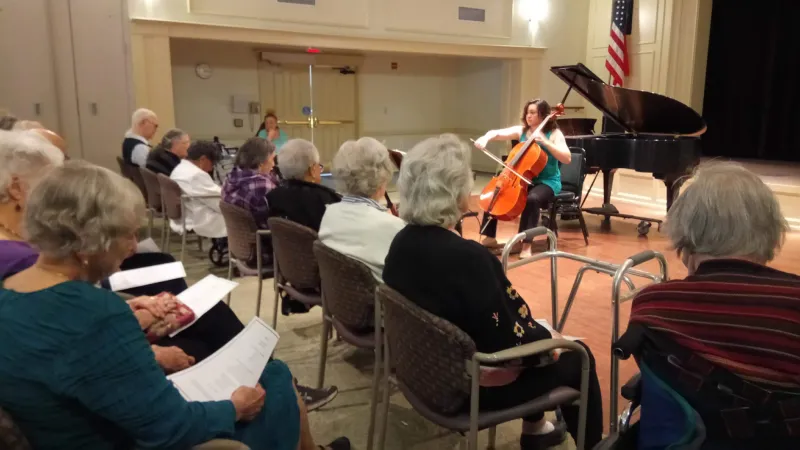
Photo: elderly Latin musician teaching young student traditional instrument community center, via music.umd.edu
The lesson doesn't start until the food is on the table. That's just how it works in the East Harlem apartment of Maestro Roberto Quispe, a 71-year-old Peruvian-born percussionist who has spent the last four decades living inside the New York Latin music scene. Every Wednesday evening, two or three younger musicians arrive at his door. They eat. They talk. Then, sometimes for hours, they play.
There's no syllabus. There's no tuition. There's no certificate waiting at the end. What there is, Quispe says, is something that formal music education almost never delivers: the whole story.
"In a school, they teach you the notes," he says, tapping the head of a cajón with two fingers. "Here, I teach you why the notes matter. The history, the feeling, the reason we play this way and not another way. You can't put that in a textbook."
Quispe is not a famous man. He's not on streaming platforms. He doesn't have a Wikipedia page. But ask around in certain circles of New York's Latin music community and you'll hear his name spoken with a reverence usually reserved for people with a lot more public profile. Because over the decades, he has quietly shaped dozens of musicians who have gone on to significant careers — and most of them will tell you the most important education they received happened at that Wednesday table.
The Invisible Network
What Quispe is doing is part of a broader, largely undocumented tradition of mentorship that runs through Latin arts communities across the United States. In Chicago, veteran salsa pianist Marisol Delgado has been holding informal weekend workshops in her Pilsen home for over a decade. In Houston, master folklórico dancer and choreographer Don Ernesto Cabrera runs an apprenticeship program out of a community center that operates almost entirely on word of mouth. In Los Angeles, composer and arranger Carmen Vidal mentors young film and TV composers through a network of connections that grew organically out of her own career.
None of these people are running nonprofits. None of them are collecting foundation grants (though a few probably should be). They're doing what their own teachers did for them — passing knowledge forward because that's what you do.
"My teacher never asked me for anything," says Marisol Delgado, who studied under a Cuban pianist in Miami before relocating to Chicago in her thirties. "She just said, 'When you know enough to teach, teach.' So I teach."
What Formal Institutions Miss
The existence of this informal mentorship network says something important about the limits of traditional music education — especially for Latin American arts traditions. University music programs and conservatories have made real progress in recent years, expanding their curricula to include non-European traditions. But there are things those institutions structurally cannot provide.
For one, context. The rhythmic vocabulary of Afro-Cuban music, for instance, carries centuries of history that shapes not just how it sounds but what it means — and that meaning is difficult to convey in a semester-long course with thirty students and a standardized assessment rubric. The same is true for Mexican son, for Andean folk traditions, for the dozens of regional dance forms that fall under the folklórico umbrella.
For another, access. Formal music education is expensive, and many young Latin American students — particularly those from immigrant families navigating economic instability — simply don't have a path into it. The mentorship network, informal and unstructured as it is, provides an alternative route.
"I had a student last year who was working two jobs and couldn't afford a single lesson at a real school," says Don Ernesto Cabrera, whose folklórico apprenticeship program in Houston has produced several professional dancers. "She came to me. Now she's performing. Tell me what school would have done that for her."
The Students Speak
Talk to the young artists who have come up through these informal mentorships and you start to understand what makes the experience different from a classroom.
Javier Mora, a 26-year-old trumpeter from the Bronx whose parents are from the Dominican Republic, spent three years studying with a veteran merengue musician he met through a mutual friend at a quinceañera gig. "He taught me to listen differently," Mora says. "Not just to music — to a room. To what the crowd needs. You don't learn that from sheet music."
Ana Fuentes, a 23-year-old dancer and choreographer in San Antonio, was taken under the wing of a Tejano dance master she met at a community festival when she was seventeen. "She didn't just teach me steps," Fuentes says. "She taught me the stories behind the steps. Why we hold our arms this way. What the footwork means historically. It changed everything about how I move and how I teach."
Both Mora and Fuentes are now beginning to mentor others — continuing a chain of transmission that has no official starting point and no planned ending.
Preservation as a Side Effect of Love
One of the less-discussed consequences of this mentorship network is cultural preservation. Many of the traditions being passed down in living rooms and community centers across the US are not widely documented. They exist in the bodies and memories of people who learned them from people who are no longer alive. When those people choose to teach, they're doing something that no archive or museum can fully replicate.
Maestro Quispe, for instance, carries knowledge of Peruvian cajón techniques specific to the Afro-Peruvian community his grandparents came from — techniques that differ meaningfully from the better-known flamenco cajón style most American musicians have encountered. Without his Wednesday sessions, some of that specificity would quietly disappear.
"I'm not trying to be a museum," he says, a little amused by the framing. "I'm just trying to make sure the music stays alive. That's all."
A Network Worth Naming
At Grupo Logosula, we believe this quiet, person-to-person transfer of knowledge is one of the most vital things happening in Latin arts culture in America right now. It's not flashy. It doesn't generate press releases. But it is producing artists, preserving traditions, and creating pathways for young people who might otherwise have no door into the world of serious musicianship.
If there's one thing we'd love to see, it's more visibility for these maestros and maestras — not to formalize what they do, but simply to honor it. The students sitting at those tables are learning something irreplaceable. And the teachers offering those seats deserve to be recognized for the gift they're giving, one Wednesday evening at a time.