Walls That Sing: How Latin Street Artists Are Turning US Neighborhoods Into Living Cultural Monuments
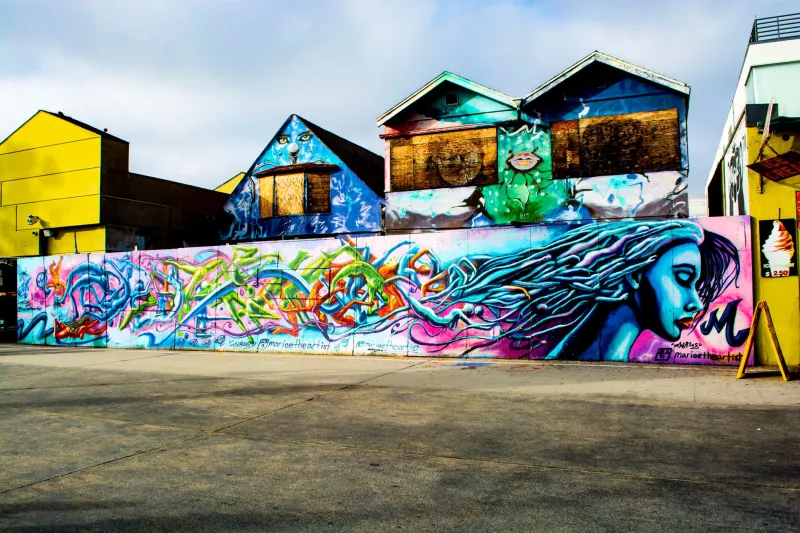
There's a moment — if you've ever walked down Cesar Chavez Avenue in East Los Angeles on a warm Saturday evening — where the street stops feeling like a street. The cumbia drifting out of a corner tienda, the smell of elotes from a nearby cart, and the massive, color-saturated mural wrapping around a building like a second skin all blur together into something bigger than any one of them alone. It feels like a concert. It feels like a homecoming.
That feeling isn't accidental. Across the United States, a new generation of Latin American muralists and street artists is deliberately designing public spaces to do exactly that — to function as cultural stages, storytelling canvases, and community gathering points all at once. And the movement is growing fast.
Pilsen, Chicago: Where Every Block Has a Backstory
If there's one neighborhood in the Midwest that's become a kind of open-air museum for Latin American visual culture, it's Pilsen on Chicago's Lower West Side. Walk down 18th Street and you'll pass dozens of murals telling the story of Mexican migration, labor struggles, and the kind of everyday joy that doesn't make the evening news.
Artist Héctor Duarte, who's been working in Pilsen for decades, is one of the neighborhood's most recognizable voices. His large-scale works often weave together indigenous Mexican imagery with scenes from contemporary immigrant life — figures mid-dance, musicians mid-strum, families mid-meal. His mural Gulliver en el País de las Maravillas became a neighborhood landmark almost overnight after it went up, drawing not just foot traffic but organized community events that use the wall as a backdrop.
"The wall doesn't just show culture," Duarte has said in interviews. "It invites people to stand in front of it, to talk, to remember who they are."
That invitation is taken seriously in Pilsen. The annual Pilsen Mural Tour, which draws thousands of visitors each summer, regularly incorporates live music — mariachi, son jarocho, even experimental electronic acts — performed directly in front of murals that serve as the visual context for what's being played. The art and the sound become inseparable.
East Los Angeles: The Original Canvas
Los Angeles has always been ground zero for the American muralism tradition, and the Chicano Art Movement that took root here in the late 1960s and '70s set the template for everything that came after. But today's artists aren't just honoring that legacy — they're building on it in ways that feel urgently contemporary.
Judith Baca's Great Wall of Los Angeles, a half-mile-long mural running through the Tujunga Wash flood control channel in the San Fernando Valley, remains one of the most ambitious public art projects in American history. But younger artists like Levi Ponce and Nyla Ramirez are taking the tradition into new territory, incorporating QR codes that link to playlists, podcasts, and oral histories — turning static walls into multimedia experiences.
Ponce, whose hyper-detailed portraits of Latin musicians and cultural figures have appeared on walls from Pacoima to Boyle Heights, sees his work as a form of cultural documentation. "A lot of the people I paint aren't famous outside of our community," he told a local arts publication. "But they're the ones who kept the music alive, who kept the dances alive. They deserve to be 30 feet tall."
His mural honoring Chicano rock pioneer Lil' Ray Jimenez in Boyle Heights became the unofficial backdrop for a street festival last year that drew over 2,000 people, with live oldies bands performing through the afternoon and into the evening. The wall wasn't just decoration — it was the reason people came.
Miami's Wynwood: Latin Roots in a Global Art Hub
Wynwood is globally famous as an arts district, but what often gets lost in the international hype is how deeply Latin the neighborhood's DNA runs. The transformation of these warehouse walls began largely through the vision of Puerto Rican developer Tony Goldman, and the artists who've left the most lasting marks on the district include a disproportionate number of Latin American voices.
Argentine artist Hyuro (before her passing in 2019) left a series of works in Wynwood that explored femininity, migration, and cultural in-betweenness with a quiet, haunting power. Colombian artist Ledania has brought a maximalist, color-drenched aesthetic that feels like a visual salsa — layered, kinetic, and impossible to ignore. Her murals in Wynwood regularly serve as the setting for cultural pop-ups, from Afro-Caribbean music showcases to spoken word nights that blend English and Spanish without apology.
The Wynwood Walls organization has increasingly leaned into programming that connects visual art with live performance, and Latin artists are at the center of that convergence. During Art Basel Miami Beach each December, the neighborhood becomes something extraordinary — a place where a mural by a Venezuelan artist might serve as the backdrop for a live performance of Venezuelan joropo music, creating a multi-sensory experience that no gallery could replicate.
More Than Decoration: The Political and Emotional Weight
It would be easy to talk about all of this purely in terms of aesthetics or tourism, but the artists themselves are clear that the stakes are higher than that. Many of these murals are direct responses to political realities — to deportation fears, to cultural erasure, to the ongoing struggle to be seen as fully American while remaining fully Latin.
In Houston's East End, a neighborhood with deep roots in the Mexican American community, muralists like Angel Quesada have painted works that explicitly reference the pain of family separation at the border alongside imagery of traditional danzón and cumbia — as if to say: we carry grief and joy in the same hands. These walls don't just celebrate culture; they defend it.
And that defense has a communal dimension. When a mural goes up in a neighborhood, it tends to generate the kind of organic gathering that no event planner could manufacture. People stop. They photograph. They argue about what it means. They bring their kids. They bring their abuelas. And often, someone brings a guitar.
The Street as Stage
What's emerging across these cities is something that feels genuinely new, even if its roots go back centuries. Latin American public art has always carried a social function — think of the great Mexican muralists like Rivera, Orozco, and Siqueiros, who used walls to speak directly to people who might never enter a museum. Today's artists are operating in that same tradition, but in an American context that adds new layers of meaning and urgency.
The streets of East LA, Pilsen, Wynwood, and Houston's East End aren't galleries with open hours. They're always on. They're always inviting. And increasingly, they're the places where the real cultural conversation about what it means to be Latin in America is happening — not in boardrooms or on streaming platforms, but on walls that anyone can see, in neighborhoods where the music never really stops.
At Grupo Logosula, we believe the rhythm of Latin America lives everywhere — in the music, in the dance, and yes, in the walls. Next time you're in one of these cities, take a walk. Let the art talk to you. You might be surprised how much it has to say.